


Spider Catapults Prey Into Ingenious Web Trap
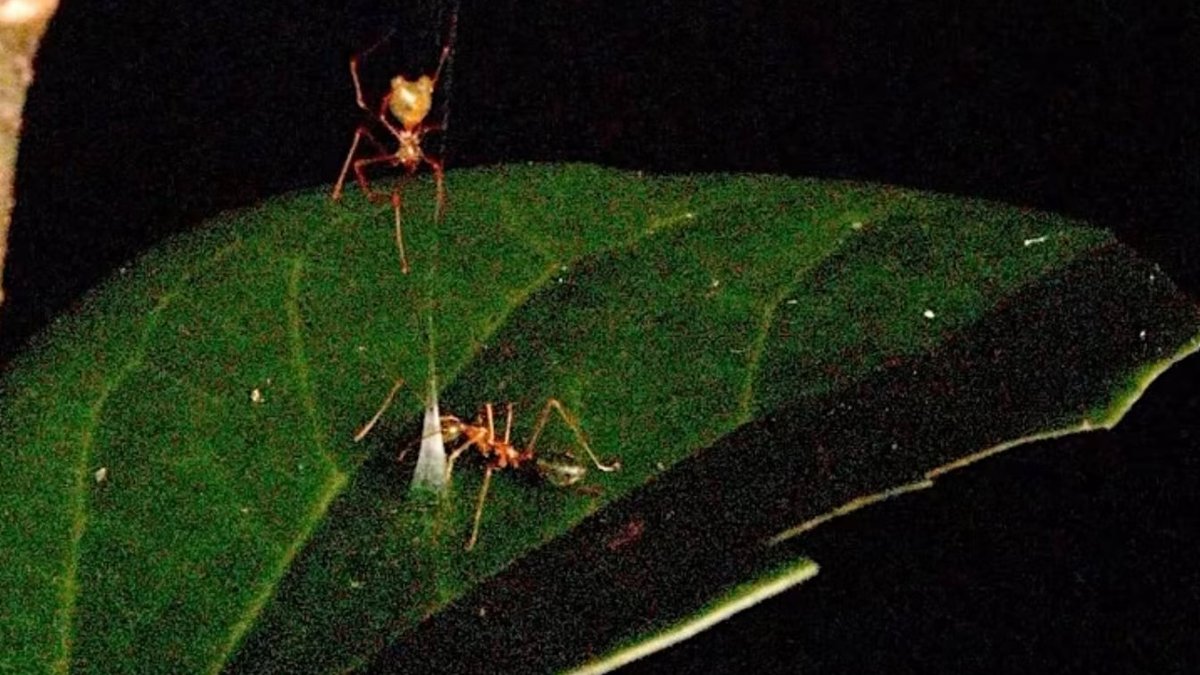
Scientists have captured high-speed footage of a newly discovered spider species in Australia building a spring-loaded snare trap that catapults prey into its web with a force that would kill a human. The ballista spider, named after an ancient Roman weapon, was recorded launching green tree ants at accelerations of up to 1,367 meters per second squared — roughly 130 times the force of gravity.
The findings were published in a recent paper in a biology journal.
The report describes the hunting method as unlike anything seen before.
The species appears to target almost exclusively one type of prey: the highly territorial and aggressive green tree ant.
Related: Bizarre Events Unfold in Recent Days
The behavior was first spotted in 2022 by Greg Anderson at the QIMR Berghofer Medical Research Institute in Brisbane. He saw a green tree ant suddenly launched into a spider trap in far north Queensland, but without specialized cameras, the movement was just a blur.
A trap that took hours to build
In early 2023, research professor Ajay Narendra of Macquarie University and postgraduate student Pranav Joshi spent 10 days and nights in rainforest near Cooktown looking for the spiders.
Using high-speed and infrared cameras, they documented the full sequence.
The nocturnal spider first builds an anchor point on a leaf, a branch, or the forest floor. It then spends up to four hours spinning between 50 and 60 vertical tension lines bundled together in a cone near the ground.
It wraps the cone with extra silk before retreating upward to wait.
Related: Creating Lasting Memories: The Magic of Photo Booths at Toronto Weddings
When the ant approaches and bites the cone aggressively, it detaches from the anchor point. The ant is catapulted more than 30 centimeters upward into the core web at accelerations above 1,300 meters per second.
Once the ant is immobilized in the web, it wraps the ant in silk before feeding. The trap is designed for a single use. After the ant is launched, the tension lines are spent.
They are known for their aggressive colony defense.
They patrol tree trunks and foliage in large numbers. The reliance on a single prey species is unusual for a predator of its size. “To capture the moment, we had to push the cameras to 5000 to 7000 frames per second, which I honestly have never had to do… when I’ve been filming animals,” Narendra told the outlet.
Related: Top 10 Perfect Personalized Gifts for Your Anniversary
Researchers aren’t sure how the spider avoids being detected while building its trap. The ant’s attraction to the cone structure also remains unclear. One possibility is that the silk itself mimics something the ant finds interesting or threatening.
The ballista spider has not been formally described with a scientific name yet.
The paper in the journal focuses on the mechanics of the trap rather than taxonomy. The species lives in rainforests of Queensland, Australia, and is small enough to be easily overlooked.
Narendra said the team plans to continue studying the spider’s ecology. The footage represents one of the fastest accelerations ever recorded in a biological system. For comparison, a cheetah’s acceleration is roughly 13 meters per second squared.


